


Simple Investing Is Smart Investing
You can succeed with a significantly simpler investment portfolio than you probably think you can.
The myth of complexity
Many investors have been convinced that investing is complex and requires significant time, effort, and expert help to be a successful investor. There are a couple of sources behind the myth that investing has to be complicated:
The financial media
You can't fill hours of television and online content every day with the advice to buy a few broad-based index funds and hold them for the long term. That sentence took seven seconds to write. To fill the airtime and attract the eyeballs advertisers want, there needs to be drama, excitement, fear, and complexity.
Wall Street
It's difficult to charge high fees for simple investing. Wall Street firms have mastered building complex investment products and selling them to individual and institutional investors.
The simple solution benefits you, the investor, greatly. It does little, however, to help the people who profit from making investing seem complicated.
Three ways simple investing beats complex investing
Much Lower Fees
According to the Investment Company Institute, actively managed mutual funds carried average annual expense ratios of 0.64%. (These are funds where an expert is paid to select investments.) Passively managed index funds, which simply hold every stock in an index with no expert selection, averaged just 0.05%.
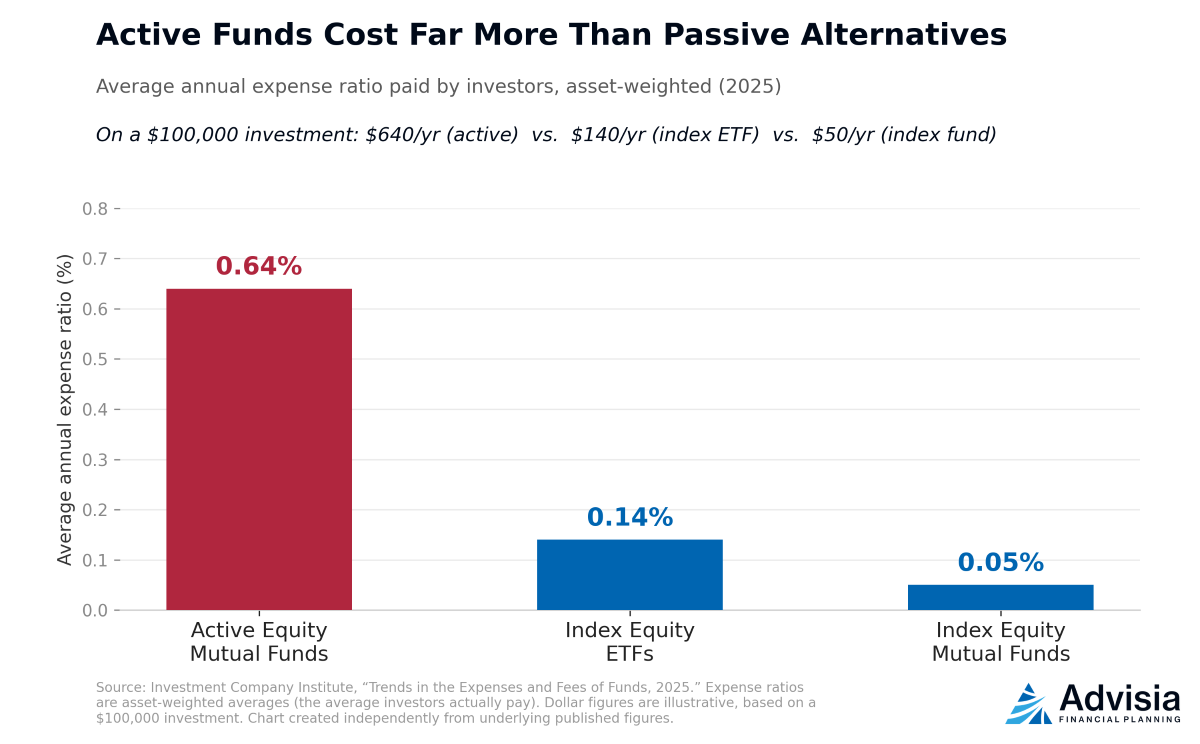
Many complex investment products carry expenses significantly higher than 0.64%.
You could argue it's worth paying higher fees for superior returns. Historically, though, that trade-off rarely pays off.
Historically better relative performance
According to the SPIVA U.S. Scorecard, 65% of actively managed large-cap U.S. equity funds underperformed the S&P 500 index in 2024. (update: in 2025 it was 79%!) In other words, an index fund tracking the S&P 500 outperformed two-thirds of professional active managers in that category over a one-year period. And you'd have paid a fraction of the price.
Over longer time horizons, almost no large-cap U.S. equity managers beat the S&P 500. Only about 9% do after 20 years. You'd have to be very lucky to pick the manager who outperforms over the long run.
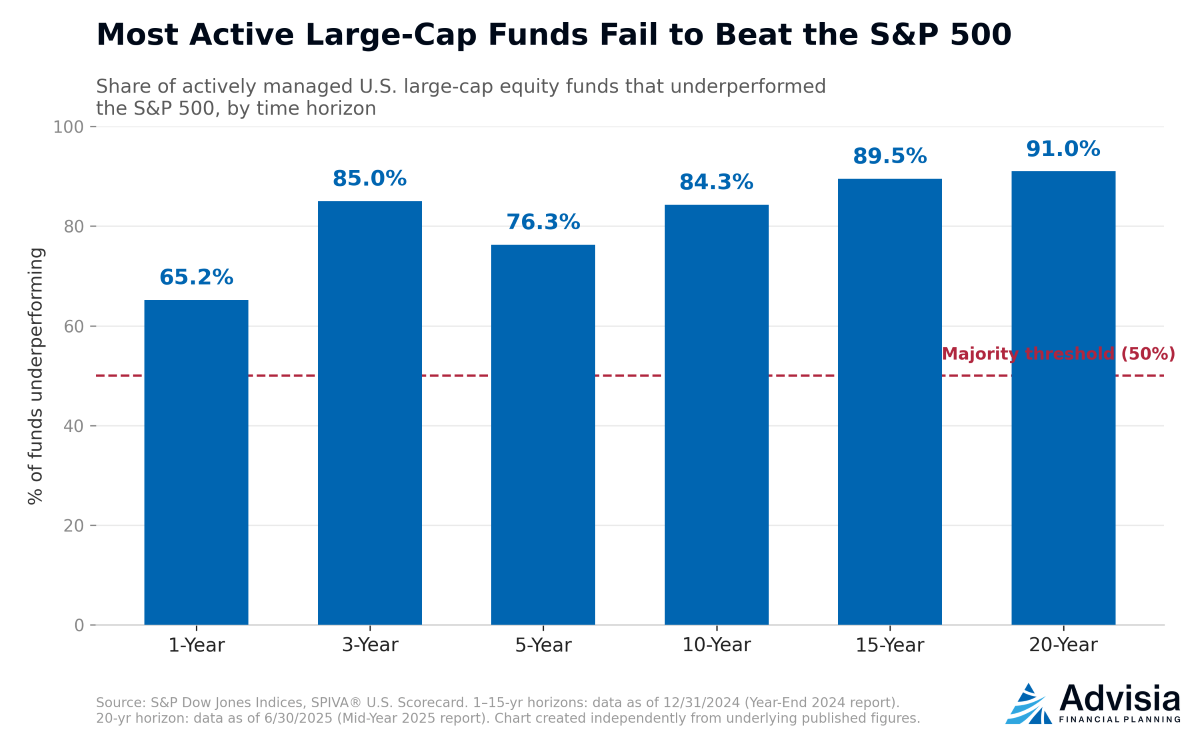
Beyond higher costs and lower historical returns, complex investing also creates more opportunities to mess things up.
Less opportunity to mess it up
Published investment returns show an accurate calculation of an investment's return over a given period. What matters more to us as investors, though, is the return we actually receive from that investment.
Studies have shown that, on average, investors tend to make poor timing decisions. They buy high and sell low. That temptation grows significantly stronger with complex investment products, especially ones investors move in and out of frequently.
Morningstar tracks the gap between an investment's reported returns and the returns the typical investor actually receives, based on when they buy and sell. For mutual funds overall, investors lose an additional 1.2% per year to poor timing decisions.
For the simplest investment type Morningstar tracks, allocation funds, the gap is only 0.1%. That's likely driven by 401(k) investors who contribute consistently and rarely make changes.
For what Morningstar calls the most volatile cash-flow funds, meaning the funds investors trade most often, the gap is a striking 1.8% per year.
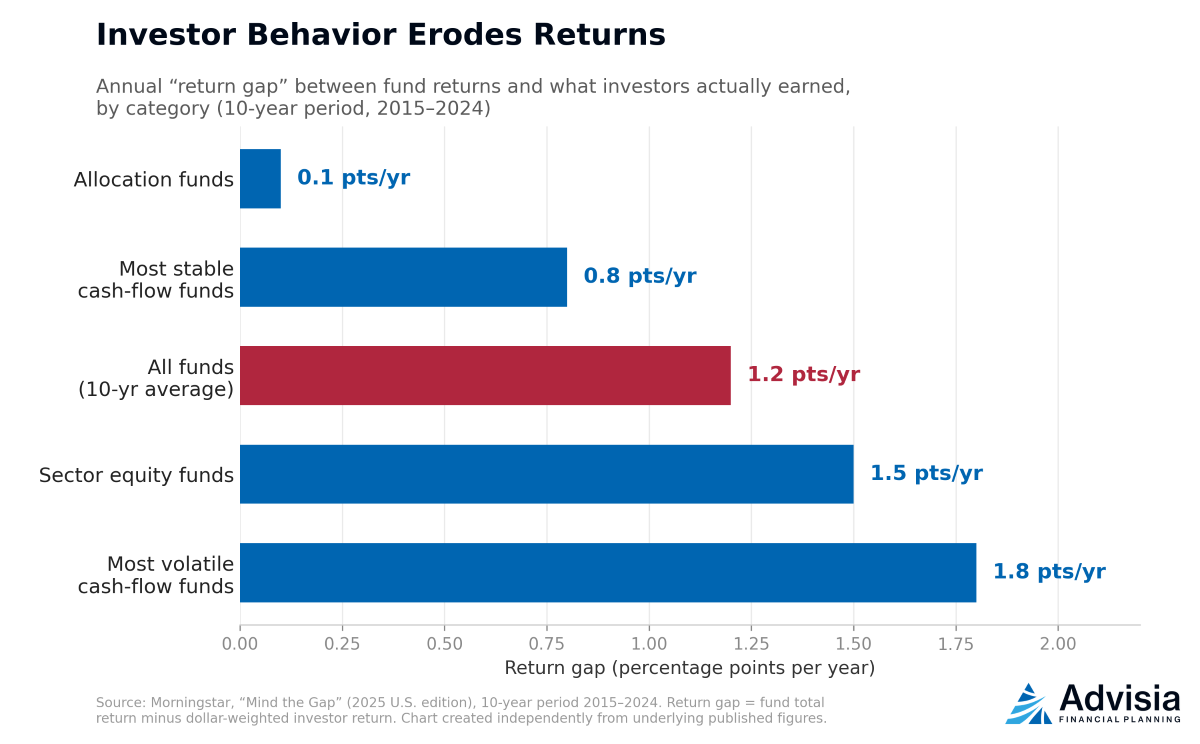
To the extent a simpler investment strategy helps investors avoid excessive trading and market timing, it has historically been rewarded.
So why doesn't everyone invest this way?
It's boring.
One solution: carve out a small portion of your portfolio, say 5%, for more exciting securities. Individual stocks, IPOs, cryptocurrency, a company you admire, whatever interests you. Even here, you can stay away from expensive, complex investment products.
This probably won't increase your returns. But if it satisfies your curiosity and keeps you from tinkering with the other 95%, that trade-off can be a real win. I do this myself, and enjoy it. I'll write another time about why you might want a small allocation to more interesting, complex securities.
Simple investing is smart investing.
